Entities, scope, and consolidated views
How the entity switcher works, what Consolidated scope actually computes, and how scope travels in links you share.
ConceptFor Business owners, Bookkeepers, Firm staff
The model
A firm contains clients. A client contains one or more companies — the legal entities that file returns. The client owns users, settings, roles, and billing. Each company owns its own ledger: its journal entries, bank accounts, bills, invoices, and financial statements.
This split is why you can give a bookkeeper access once and have them work across every company you own, while each company's financial statements stay properly separate.
Using the entity switcher
The switcher offers each company individually, plus the combined client view. Choosing a company narrows every list, report, and total on the page to that company. Choosing every company widens them to the whole client.
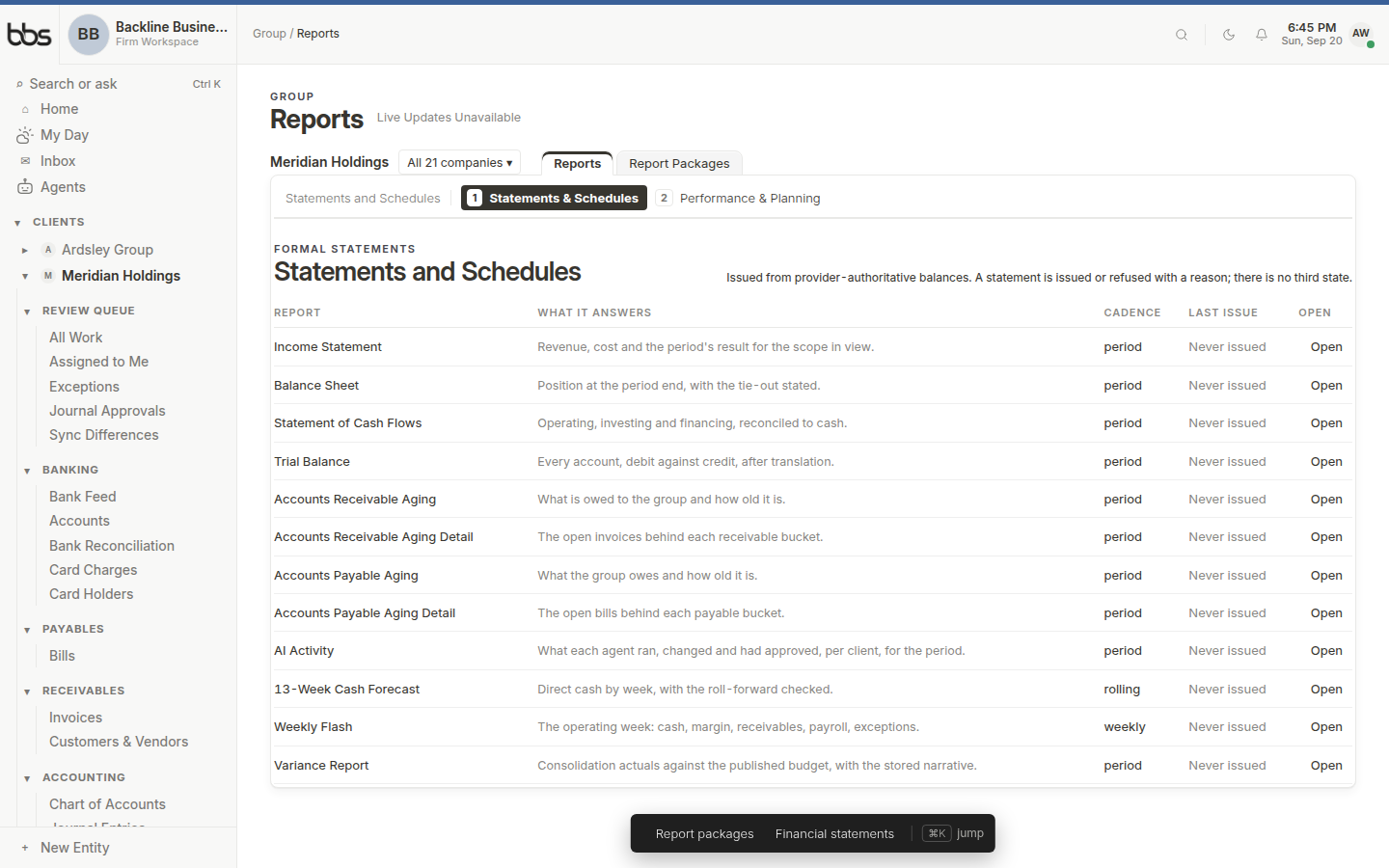
Scope is set once and respected by every screen beneath it. Period is not a global filter.
What Consolidated actually computes
Consolidated scope is a genuine combination, not a stack of separate statements. Balances across entities are summed by account, so a consolidated Balance Sheet has one Cash line covering every entity's cash.
Intercompany activity is a separate concern. Summing entities without eliminating intercompany balances overstates both sides. The Consolidation report is the surface that applies eliminations and shows entity-level detail alongside the eliminated total.
Intercompany entries
When one entity pays a cost on behalf of another, both sides need an entry. The intercompany journal entry screen creates the paired entries together so the two sides cannot drift out of agreement, and marks them so the Consolidation report can eliminate them.
Situations that call for an intercompany entry:
- One entity's bank account pays another entity's vendor bill.
- A management fee charged from a holding company to an operating company.
- A loan or capital contribution between related entities.
- Shared payroll cost allocated across entities.
Common questions
Yes. Access is granted per entity, so a bookkeeper who handles only one of your companies sees only that company — including in Consolidated scope, which shows them only the entities they can access.
See alsoUsers, roles, and who sees what
Yes. Each legal entity carries its own fiscal calendar and its own period locks. Consolidated reporting across entities with different year ends is possible but should be read carefully — say so explicitly if you hand such a statement to a third party.
The chart is maintained at the organization level so that consolidation is meaningful — the same account code means the same thing everywhere. Accounts that are irrelevant to a given entity simply carry no activity there.
Was this useful?